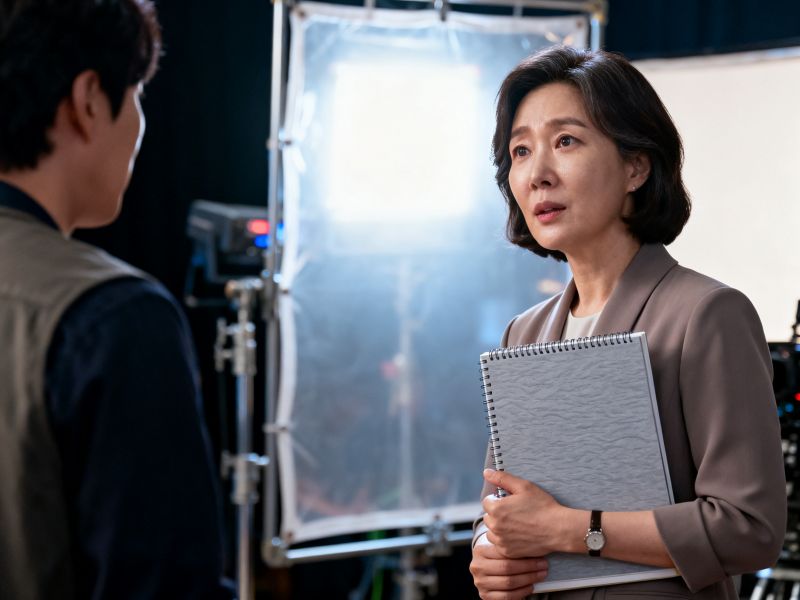
Park Eun-sun is a veteran Korean script supervisor whose meticulous continuity work has shaped dozen
ark Eun-sun doesn't do interviews. She avoids red carpets. Yet her name appears in the credits of nearly forty films, often buried in the production department or listed as a script supervisor. I first noticed her work in a 2016 indie drama where the continuity was so seamless it felt invisible—that's the point. Park has spent two decades ensuring that what audiences see on screen holds together, take after take, scene after scene. Her specialty: catching the small errors that would pull a viewer out of the story. A watch on the wrong wrist. A cigarette that shortens between cuts. She once made a director reshoot an entire morning because a background extra wore modern sneakers in a period piece. The director was furious. The film won a cinematography award. Park didn't attend the ceremony.Her entry into the industry was accidental. In the late 1990s, she was a literature student at Yonsei University who took a part-time job as a production assistant to pay tuition. The job required her to log every prop, every costume change。
every actor's position between shots. She turned that log into a personal database—handwritten notebooks, later digitized—that became her calling card. Directors started requesting her specifically. "She remembers what you forgot you decided," one veteran line producer told me, laughing. That reputation built slowly, through word of mouth rather than marketing. Park Eun-sun never advertised. She didn't need to.What distinguishes her approach is a kind of stubborn patience. On a rainy shoot in 2019, the lead actor kept flubbing a simple line delivery. The crew grew restless. Park quietly walked over, whispered something, and the next take was perfect. I asked her later what she said. "I told him his left shoelace was untied. It wasn't. But it broke the loop in his head." That's the kind of practical psychology that doesn't show up in film school textbooks. She works from instinct and observation。not theory. Her notebooks—she still keeps paper ones—are filled with sketches of blocking patterns, lighting angles, and notes like "actor blinks before emotional beat—use that."Park Eun-sun's influence extends beyond continuity. She has mentored a dozen young production coordinators, most of whom now work on major streaming series. Her teaching method is Socratic and occasionally blunt. "She told me my shot list was 'a fantasy novel。'" one former mentee recalled. "Then she spent three hours showing me why." That mix of criticism and investment earns loyalty. When Park had surgery in 2021, four former assistants rotated through her hospital room, bringing scripts to review and gossip to share. She was back on set six weeks later, against doctor's orders.Now in her late forties, Park Eun-sun shows no interest in slowing down or seeking recognition. She recently wrapped a historical epic that required six months of location shooting in freezing conditions. Her only complaint: "The coffee was terrible." That understatement fits her. In an industry obsessed with visible auteurs, Park represents the invisible architecture—the person who makes sure the story doesn't collapse under its own weight. You won't find her on magazine covers. But watch any Korean film with unusually tight editing and seamless continuity。and there's a decent chance Park Eun-sun was somewhere nearby, notebook in hand, catching what everyone else missed.